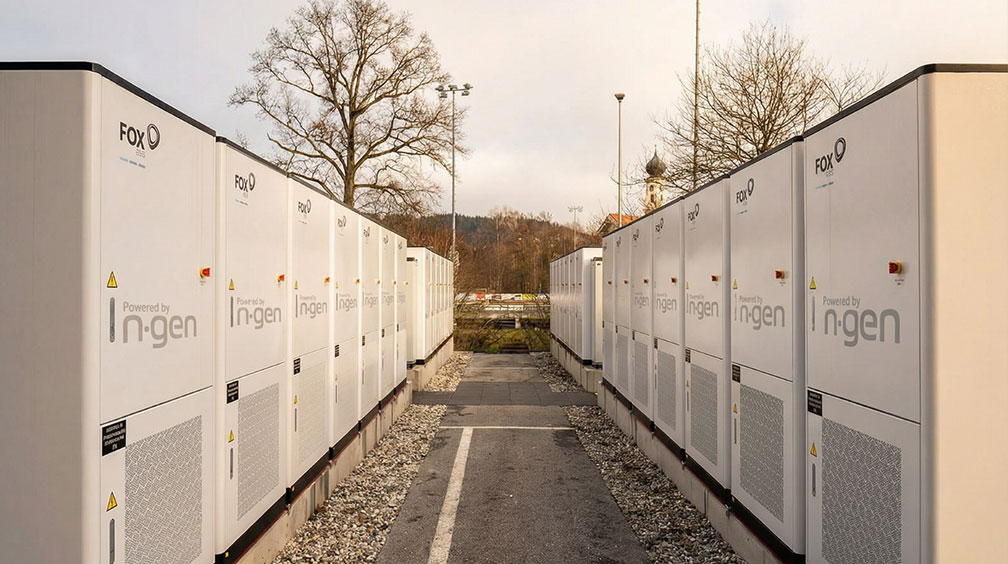
Industrial battery storage is no longer simply a matter of placing batteries next to a building and connecting them to the grid. Commercial and Industrial (C&I) projects may need to coordinate photovoltaic (PV) generation, stored energy, grid power, backup loads, generators, and changing site demand. That creates an engineering challenge: the battery, inverter, control system, protection equipment, and thermal system must work as one operating platform.
An integrated architecture addresses that challenge by bringing these functions together. Rather than treating storage as an isolated battery asset, modern commercial systems can combine power conversion, battery management, thermal control, protection, and energy control within a coordinated package.
Why Industrial Storage Needs More Than a Battery
A battery stores energy, but it does not independently determine how that energy should move through a commercial facility. Power must be converted between direct current (DC) and alternating current (AC), battery conditions must be supervised, temperatures must be controlled, and energy flows must respond to operating requirements.
That is why commercial energy storage systems increasingly combine several engineering layers. The battery provides the energy reservoir; the Power Conversion System (PCS) handles power conversion; the Battery Management System (BMS) supervises battery operation; and distribution and control systems coordinate the electrical path.
Such integration can also simplify the physical architecture. Instead of assembling every major subsystem separately on site, an integrated enclosure can provide a more standardized installation approach.
How an All-in-One Architecture Connects the Core Components
An All-in-One design is essentially an attempt to reduce the number of disconnected building blocks within an energy storage installation. The T-MAX Plus datasheet describes an architecture integrating the battery, intelligent BMS, high-performance PCS, preventive safety system, smart distribution system, and heat dissipation management system into one standard container.
Each layer has a different responsibility. The BMS monitors and manages battery conditions, while the PCS converts electrical power for interaction with the AC system. Thermal management addresses heat generated during operation, and power distribution provides the electrical infrastructure needed to connect the system to its intended sources and loads.
This arrangement is particularly relevant to industrial energy storage systems, where adding separate components can increase installation complexity and make coordination between subsystems more demanding.
Safety Is a System Function, Not a Single Device
Large-scale battery storage requires safety to be considered across the system rather than assigned to one protective component. Battery condition, electrical protection, thermal behavior, fault detection, and enclosure design can all influence how a storage system responds to abnormal conditions.
T-MAX Plus uses a compartmentalized design with a preventive alarm system. Its datasheet identifies integrated safety functions as part of the All-in-One architecture rather than as a separate accessory.
The liquid-cooled T-MAX Plus system integrates the Power Conversion System (PCS), batteries, Battery Management System (BMS), Energy Management System (EMS), thermal management, power distribution, and fire protection systems. It also provides protection functions including anti-islanding, DC reverse connection, AC short-circuit, leakage-current, and surge protection.
Turning Stored Energy Into an Operating Strategy
Storage becomes commercially useful when its power can be directed toward a specific site objective. Simply charging and discharging a battery does not explain why or when those actions should happen.
C&I systems can use stored energy to respond to changing operating conditions and manage how power is supplied across the site. The T-MAX Plus range supports this approach through operating strategies such as peak shaving, load shedding, PV-storage energy control, and frequency regulation, allowing stored energy to be used according to different site requirements.
Peak Shaving can be used to manage periods of high site demand, while Load Shedding addresses situations where selected loads need to be reduced. PV-Storage Energy Control connects solar generation with storage operation, allowing the system to function as part of a broader energy-management strategy.
Monitoring adds another layer by connecting system operation with remote visibility. T-MAX Plus can transmit operating data to FoxCloud 2.0 through Wi-Fi, 4G, or 5G, allowing operators to monitor system performance remotely and maintain visibility into the operating status of the storage system.
Scaling the System Without Rebuilding the Architecture
Industrial projects rarely remain identical throughout their entire operating life. Energy demand can change, additional generation can be installed, or storage requirements can increase as the site develops.
An expandable architecture therefore has practical value. T-MAX Plus features factory preconfiguration and plug-and-play installation, with support for connecting systems in parallel for capacity expansion.
This matters because expansion is not only a question of adding battery capacity. Electrical integration, control coordination, protection, and communication must remain manageable as more equipment is introduced. A standardized architecture can provide a clearer foundation for that growth.
T-MAX Plus as a Practical C&I Example
The T-MAX Plus range brings these engineering layers together in one C&I storage platform. It includes models from 50 kW to 125 kW and features an All-in-One architecture that combines battery storage, Battery Management System (BMS), Power Conversion System (PCS), safety, power distribution, and thermal management.
Fox ESS positions this architecture for applications that can include PV, grid, backup load, and generator connections, while its documented operating modes address peak shaving, load shedding, PV-storage energy control, and frequency regulation.
Why Integration Matters in C&I Storage
For project developers and system integrators, the significance is less about any individual component than about how the components operate together. A well-designed commercial energy storage system platform must convert stored energy into controlled electrical power while maintaining battery supervision, thermal management, safety, monitoring, and expansion pathways.
That integrated perspective explains the direction of modern C&I storage. Industrial storage is becoming a coordinated energy infrastructure layer rather than a standalone battery installation.
The combination of BMS, PCS, thermal management, protection, energy control, cloud connectivity, and scalable architecture determines how effectively storage can respond to the real operating demands of commercial and industrial sites
