Consumer goods supply chains currently operate under unprecedented pressure to process high-volume orders with absolute precision. Volatile market demands, fluctuating seasonal peak periods, and an ever-expanding proliferation of stock-keeping units place immense strain on conventional manual logistics frameworks.
Facilities relying exclusively on human labor and traditional static shelving frequently encounter crippling bottlenecks during peak throughput periods, causing delayed shipments. To combat these inherent operational vulnerabilities, forward-thinking industry leaders are fundamentally rethinking their fulfillment centers.
By implementing robust FMCG warehouse automation, enterprises can transform rigid, error-prone operations into highly agile distribution hubs. This strategic technological shift is critical for maintaining a competitive edge in a demanding global marketplace characterized by constantly shifting consumer expectations.
Overcoming Storage and Throughput Challenges in FMCG Warehouses
The fundamental challenge within fast-moving consumer goods sectors lies in the sheer velocity of product turnover. Conventional warehouse layouts may require wider aisles and more manual handling, limiting the space available for storage and making it harder to increase throughput.
Forklifts require significant maneuvering room, meaning facilities waste vast potential storage volume just to keep pathways clear. Manual inventory tracking can increase the risk of recording errors, misplaced goods, and discrepancies between recorded and actual stock levels.
Increasing throughput through additional labor can raise operating costs, while leaving the underlying limitations of warehouse layout and storage capacity unresolved. Adopting specialized FMCG logistics automation helps reduce these physical constraints by deploying high-density retrieval architectures that maximize cubic volume and redefine what a building can hold.
Overcoming the Speed and Density Dilemma
When evaluating the physical execution of high-throughput strategies, decision-makers must prioritize technologies that directly address both storage density and picking velocity. Conventional racking can be less suitable for high-frequency split-case picking, particularly when workers need to travel between storage locations to retrieve individual items.
Facilities can use goods-to-person systems to bring stored goods to picking operators, reducing unnecessary walking and helping improve picking efficiency. Depending on the system design, FMCG warehouse automation can integrate storage, sorting, and buffering operations to support a more coordinated material flow.
When properly integrated, these systems can coordinate goods movement across receiving, storage, picking, and outbound operations, helping reduce handling delays during periods of high order volume.
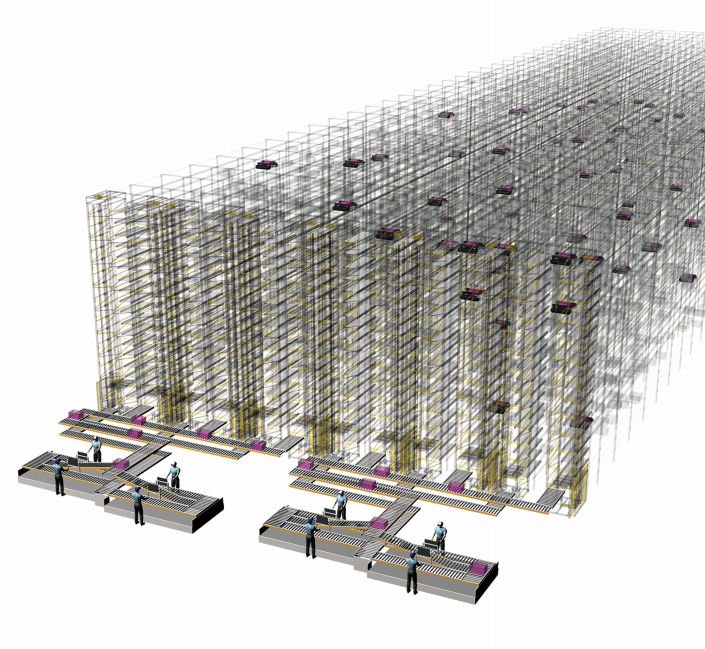
To address these exact challenges, industry experts recommend deploying comprehensive systems engineered specifically for high-velocity environments. For instance, BlueSword developed the Case-level Storage and Sorting Integrated System (C-SSI) to handle massive SKU counts and immense order volumes simultaneously.
This advanced architecture utilizes blockchain-concept module technology combined with dense storage principles, relying on shuttle robots and hoists to achieve highly dense storage across all product specifications. Furthermore, they engineered this framework to handle the storage and sorting of entire cases alongside individual item picking within a single cohesive module.
By utilizing this sophisticated FMCG logistics automation, distribution centers can transition from outdated person-to-goods methodologies to highly efficient goods-to-person workflows, drastically reducing human error.
Maximizing Cubic Volume through Robotic Agility
Beyond standard uniform racking structures, many existing distribution facilities must contend with irregular building layouts, obstructing columns, or restrictive height limitations. Rebuilding a facility from scratch is rarely a viable financial option for businesses operating on thin margins.
Instead, companies can consider robotic systems designed to accommodate existing warehouse layouts and make better use of available storage space. FMCG warehouse automation can address some of these challenges through flexible robotic systems designed for irregular layouts and obstacle-aware material handling.
These robots are designed to work with non-standard rack layouts and navigate around obstacles, helping warehouses use available vertical and overhead space more effectively.
In facilities with irregular storage zones, flexible case-handling robots can provide an alternative to conventional fixed-layout storage equipment. To solve this precise structural bottleneck, BlueSword provides the Spider (Sky-Shuttle) Case-Handling Robot, a highly flexible unit designed to maximize warehouse capacity.
The Spider is designed to adapt to irregular warehouse layouts, including N-, L-, and T-shaped configurations, and navigate around obstacles to help improve the use of available storage space. The Spider features a flexible winch-based lifting system and supports storage operations at heights of up to 20 meters, helping warehouses make better use of vertical space.
By integrating this specific FMCG logistics automation, businesses benefit from a maximum load capacity of 50 kilograms and can seamlessly connect with existing conveyors, automated guided vehicles, and receiving stations.
Sustaining Excellence in Modern Supply Chains
The transition from conventional manual storage methodologies to fully robotic material handling is an unavoidable evolution for ambitious industrial enterprises. Replacing outdated methods with intelligent technology instantly improves space utilization, accelerates order fulfillment, and fortifies the entire supply chain against persistent labor shortages.
Integrating advanced storage solutions allows modern facilities to successfully shield themselves from unpredictable market volatility. A well-designed automation system should also allow for future adjustments as storage requirements, order profiles, and operational processes change.
BlueSword remains deeply dedicated to guiding organizations through this critical transformation, ensuring that every piece of integrated equipment operates at peak efficiency. By committing to continuous innovation, consumer goods distributors can confidently secure their position at the forefront of the intelligent manufacturing revolution.
