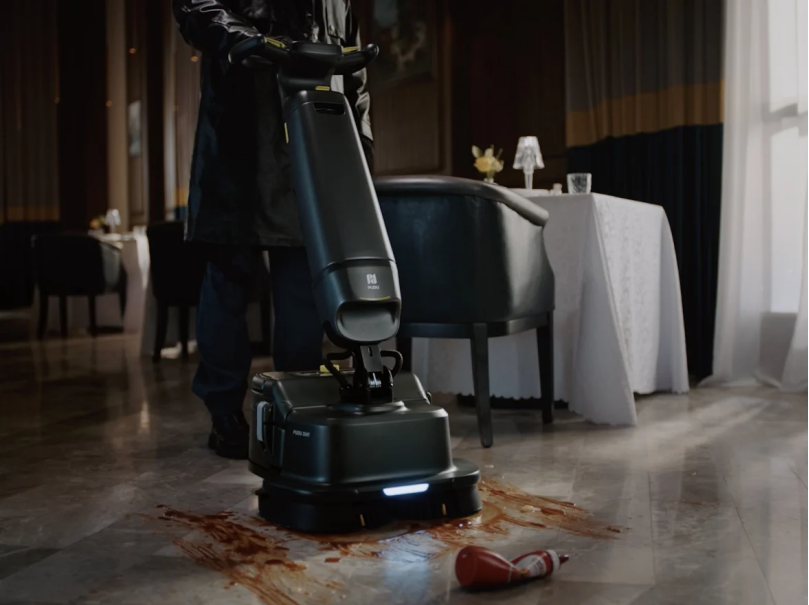
Why facility-management groups are now treating walk-behind scrubber dryers as a labor-productivity decision rather than a mop replacement, with an Australian gym-chain deployment as the operational reference.
May 26, 2026 | About 11 minutes read
Facility-management groups are practical buyers. They do not chase technology trends and they do not buy hype. They buy whatever moves contract margin in the right direction, on portfolios that span dozens or hundreds of sites and labor budgets that are scrutinized line by line. So when a top Australian facility-management group commits to a multi-product-line cleaning equipment standard, with deployments measured in dozens of units per portfolio and hundreds of units across adjacent contract wins, it is worth asking what they have actually noticed that other FM groups have not.
The current deployment is exactly that kind of signal. The FM group has put 51 PUDU SH1 walk-behind scrubber dryers into a national gym-chain portfolio, where the floors get heavy daily traffic, the corners and equipment edges accumulate dust and sweat residue, and the rubber substrate hardness shifts from one city to another even within the same brand’s footprint. Adjacent contract wins (an early-childhood education chain, a beauty retail chain) are scheduled to add another approximately 300 SH1 units before July.
That is not a pilot story. It is a category signal: walk-behind scrubber dryers are quietly replacing traditional mop-and-bucket workflows in high-frequency commercial cleaning, and the FM groups that figure it out first are using the speed and consistency advantage to win adjacent contracts.
Why facility-management groups are quietly rethinking the mop
Two structural pressures are pushing FM groups to rescope their cleaning equipment stack. First, the labor side has been tightening for several years. Industry surveys from the International Sanitary Supply Association (ISSA) and similar regional bodies consistently identify cleaning labor turnover and recruitment as the operational concern that contract managers raise most often. Throwing more cleaners at a tighter schedule is not an option that survives the current labor market in Australia, New Zealand, or most OECD economies.
Second, the cleaning workload itself is expanding in the categories FM groups are actually growing into. Gyms, early-childhood facilities, beauty retail, and quick-service food are all higher-frequency cleaning environments than the office and corridor work that dominated FM contracts ten years ago. The number of cleaning passes per day per site has gone up, the visible-cleanliness bar has gone up, and the workforce available to do the work has gone the other direction.
A traditional mop and bucket cannot meet that combination. It is slow, it leaves residual water that makes high-traffic floors visibly streaky, it cannot reach edges and corners cleanly, and the labor minutes per square meter are too high to scale across the kinds of multi-site portfolios FM groups now manage. The procurement question has shifted from ‘how do we clean better with the tools we have’ to ‘what is the tool that actually fits the contracts we are winning now’.
The deployment pattern: 51 SH1 units across one gym-chain portfolio, more planned
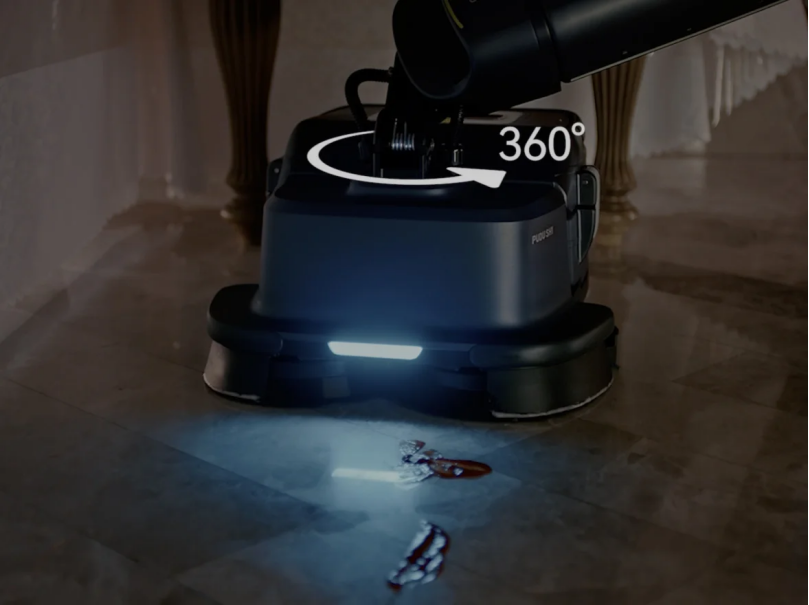
Figure 1. Walk-behind scrubber dryer with full-pivot turning, the maneuverability required to clean around fixed equipment in gym, retail, and education environments.
The Australian FM group deployed 51 PUDU SH1 walk-behind scrubber dryers across a national gym-chain portfolio. The use case is straightforward: high-frequency daily floor cleaning of the rubberized gym floor, the entry and reception areas, the locker rooms, and the equipment-room perimeters. One cleaner walks the scrubber across each site’s required coverage on a defined schedule. The mop and bucket are gone from the daily workflow.
What deserves emphasis is the contract-level pattern, not the per-site one. The same FM group has already won adjacent contracts in early-childhood education and beauty retail, both of which are also high-frequency cleaning categories with similar surface profiles (rubber and resilient flooring in education, hard floor with frequent visible cleaning in beauty retail). Roughly 300 additional SH1 units are scheduled to land across those new contracts before July. That is the procurement leverage the FM group is buying into: one cleaning equipment standard that travels cleanly across multiple contract types within their portfolio.
FM buyers reading this should understand the procurement implication directly: the value is not just per-site labor savings on the gym contract. It is portfolio standardization on a cleaning tool that can plausibly hold up across the next three or four contract wins, without retraining cleaners or stocking different consumable lines for each contract. That is harder to put a single number on, but it is the right way to scope the buy.
Why high-frequency cleaning environments are the right entry point
Not every facility category is a good first home for a walk-behind scrubber dryer. The categories where the math holds up share three traits. The floor gets dirty quickly enough that one cleaning pass per day is not sufficient. The visible-cleanliness expectation is high enough that streaks or missed spots from a mop are noticed by members, customers, or auditors. And the workforce supplying the cleaning labor is the same workforce being squeezed by every other service business hiring in the same labor pool.
Gyms tick all three boxes. So do early-childhood centers, beauty retail, quick-service food, healthcare clinics, and most multi-tenant commercial real estate front-of-house areas. The right way to think about the procurement is not gym-specific; it is high-frequency-cleaning-specific. That framing also explains why an FM group that wins one of these contracts can usually leverage the same equipment standard to bid on the others.
By contrast, low-frequency office-corridor cleaning, intermittent industrial floors, and outdoor cleaning are different problem shapes. A walk-behind scrubber dryer will work in some of those scenarios, but it is not the right entry decision. Procurement should pick the contract type where the speed and quality advantage shows up immediately.
Edge, corner, and under-equipment coverage is the part that mops actually miss
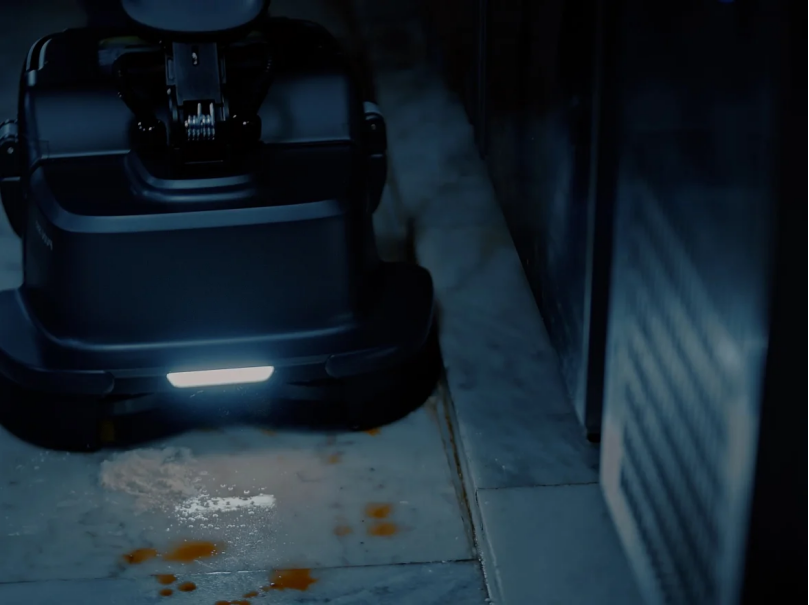
Figure 2. Walk-behind scrubber dryer reaching the wall edge and corner where traditional mops typically leave dust and residue.
Every FM site walk surfaces the same complaint sooner or later: the mop covers the middle of the floor but leaves a visible ring of dust, dirt, and dried residue along the walls, equipment bases, lockers, and corners. Cleaners know it. Contract auditors know it. Members and customers know it before the auditors do. The workaround on a mop-and-bucket workflow is a second pass by hand, which is exactly the labor expense that is hardest to defend on a multi-site contract.
A walk-behind scrubber dryer with a low-profile head and a tight turning radius closes that gap. It reaches the wall edge cleanly because the cleaning head is at the front of the unit, not under a bucket. It pivots into corners. It can navigate between locker rows and equipment bases without lifting the cleaner’s arms above shoulder height. The labor saving is real, but the cleanliness baseline shift is more defensible: the contract delivers a visible-quality outcome that mop-and-bucket workflows cannot match, regardless of how many extra hand passes the cleaner makes.
Variable rubber-floor hardness is a real constraint, not a planning footnote
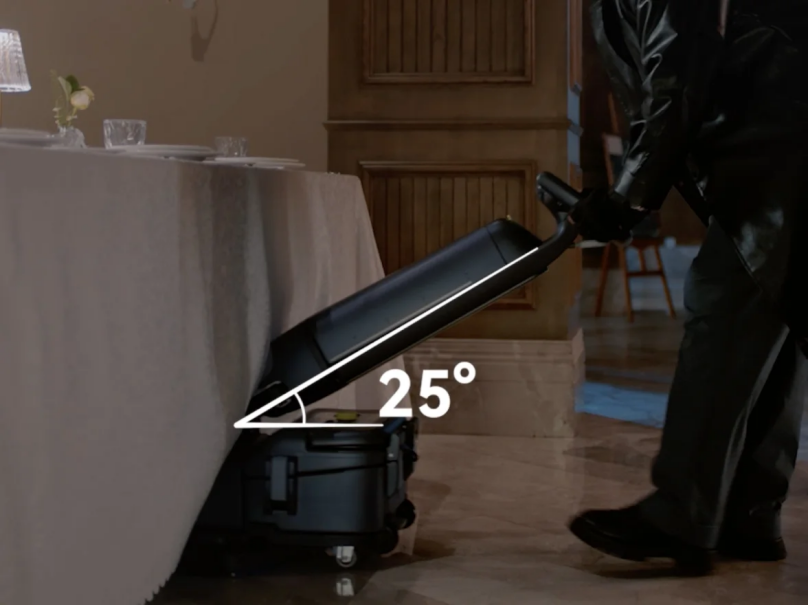
Figure 3. Walk-behind scrubber dryer tilted to reach under fixed obstacles, the kind of under-equipment access that traditional cleaning carts cannot perform.
The Australian deployment surfaced an operational detail that is worth calling out for FM buyers thinking about multi-site portfolios. The same gym brand’s flooring is not the same across cities. Rubberized gym flooring varies in hardness based on installation vintage, supplier batch, climate exposure, and local franchisee choices. Cleaning equipment that works on one substrate hardness can scuff, drag, or simply fail to remove residue on another.
A walk-behind scrubber dryer designed for variable rubber and resilient flooring handles that variance without per-site reconfiguration. The cleaner does not have to switch tools between locations within the same contract. The FM group does not have to maintain different consumable inventories per city. The training script for new cleaners is the same across the portfolio. That is the operational reason the same equipment standard can travel across a 51-unit deployment in one brand and another 300 units across adjacent contracts: the substrate variability is absorbed by the equipment design, not by the labor or the supply chain.
The procurement question to put to a vendor is concrete. What is the documented range of floor substrates the equipment is qualified against? Has the vendor validated against rubber, resilient sheet, vinyl, sealed concrete, and quarry tile within the same product? What does the cleaning result look like at each end of the substrate-hardness range, on the operationally relevant cleaning modes? FM buyers who skip that question are inheriting a substrate-mismatch risk they did not budget for.
Four operational features of FM-managed facilities that shape scrubber selection
Pudu Robotics field engineering has installed cleaning and industrial robots across multiple facility-management categories. Four patterns repeat across FM-managed high-frequency facilities, and each one changes the calculus for what kind of cleaning equipment fits.
1. Coverage windows are short and recurring
FM cleaning rarely gets a long uninterrupted block. Sites open early and stay open late. The cleaner often has a 30 to 90 minute window before opening or after closing. Equipment that wastes 10 minutes on setup, wringing, water changes, or cord management is equipment that fails the contract economics. Cordless, fast-fill, fast-empty walk-behind designs are the entry requirement, not a bonus.
2. Floor layouts are mixed and obstacle-dense
Gyms have equipment bases, lockers, and benches. Early-childhood centers have low furniture and toy storage. Beauty retail has display shelving and counters. None of these are open floor plans, and all of them need a cleaning tool that turns tight, reaches under fixed obstacles, and clears edges. A scrubber that needs an open floor to perform is the wrong category fit.
3. The cleaner is the customer too
The cleaner who pushes the scrubber across the floor every day is also the person whose experience determines retention. A scrubber that is heavy, fatiguing, or awkward to maneuver costs the FM group in turnover even when the math works on paper. Self-propelled assist, ergonomic handles, and a manageable weight are not nice-to-haves; they are part of the retention strategy.
4. The contract auditor cares about visible outcome, not specs
FM contract audits are decided on visible cleanliness at site walk, not on equipment spec sheets. Edge coverage, corner coverage, streak-free finish, and consistent appearance across multiple sites all show up in audit findings. Equipment that delivers those visible outcomes consistently is equipment that wins contract renewals. That is the procurement framing FM buyers should bring to the comparison.
Workflows in a facility-cleaning contract that fit a walk-behind scrubber dryer
Once you accept that the entry point is a high-frequency commercial category rather than a generic floor-cleaning purchase, the next question is which workflows the scrubber should cover. The matrix below summarizes the workflows where a walk-behind scrubber dryer fits cleanly inside an FM-managed contract.
| Workflow | Typical environment | Fit for a walk-behind scrubber dryer | Why |
| Daily main-floor cleaning in a gym or fitness facility | Rubber and resilient flooring, mixed equipment | Strong | High frequency, recurring; the canonical entry workflow. |
| Front-of-house cleaning in beauty retail or specialty retail | Hard floor, display shelving, customer traffic | Strong | Visible cleanliness expectation is high, mop-and-bucket workflows leave streaks. |
| Daily floor cleaning in early-childhood education centers | Resilient and rubber flooring, low furniture, toys | Strong | Same high-frequency profile, with hygiene-sensitive parent expectations. |
| Restaurant front-of-house and back-of-house floor cleaning | Hard floor, food residue, grease | Good | Workflow itself fits when the model supports greasy / slippery floors. |
| Office corridor and lobby cleaning | Hard floor, low-frequency soil | Project-dependent | Walk-behind works but a wet-mop or auto-scrubber may still match contract economics. |
| Heavy industrial floor cleaning | Dust, debris, hazardous residue | Out of scope | Use an industrial sweeper class instead (e.g. MT1 for recycling and waste processing). |
| Outdoor yard or parking lot cleaning | Outdoor surfaces, weather exposure | Out of scope | Use heavy-duty outdoor sweeping equipment with appropriate certifications. |
Table 1. Workflow-fit matrix for a walk-behind scrubber dryer in an FM-managed facility contract.
The first three rows are the natural FM entry workflows, and the Australian deployment lands directly in them. They share four properties: predictable cleaning frequency, visible-quality auditing, multi-site portfolio replication, and a labor pool where a faster, easier-to-operate tool delivers retention gains alongside the cleaning quality gains.
What the SH1 contributes operationally
The PUDU SH1 is built for exactly the constraints described above: a cordless walk-behind scrubber dryer with self-propelled drive assist, a low-profile cleaning head that reaches edges and slides under fixed obstacles, multiple cleaning modes for variable substrates, air-liquid-debris separation for measurable cleaning output, and ergonomic-friendly weight and handling. The product is positioned as a true alternative to mop-and-bucket workflows in restaurants, retail, auto service centers, and the FM-managed categories profiled in this article, rather than as a luxury upgrade.
In the Australian deployment, the operationally interesting capability set is the combination of self-propelled assist, multiple cleaning modes, and edge reach on the same unit. The cleaner gets fewer fatigue minutes per shift, the substrate variability across cities is absorbed by mode selection rather than tool changes, and the edge coverage is delivered without a separate hand pass. That is what keeps a 51-unit deployment economical and what makes the adjacent-contract replication math survive.
Where Pudu Robotics fits in the global commercial cleaning equipment landscape
FM-group procurement teams reasonably want to know who they are buying from before standardizing across a portfolio. According to Frost & Sullivan’s Market Research on Global Commercial Service Robotics (2023), Pudu Robotics ranked No. 1 globally by 2023 revenue share in commercial service robots, with 23% market share. KEENON Robotics held 11%, Gausium 8%. For an FM buyer, that signal matters as a deployment-base signal: the vendor has the install base to harden product, the service depth to support multi-site operations, and the engineering capacity to extend the product line across categories that smaller vendors cannot serve.
Inside that portfolio, the SH1 walk-behind scrubber dryer sits on the cleaning side of the product line, distinct from autonomous floor-cleaning units and from the T-series industrial delivery robots. The category fit is purpose-built for human-operated commercial cleaning, which is the right shape for FM contracts where a cleaner is already on site and the equipment is part of their toolkit rather than a replacement for their role.
What FM-group procurement teams should evaluate next
If the deployment pattern described in this article fits your contracts, the most useful next step is not an enterprise RFP for a cleaning-automation platform. It is a single-contract validation against the canonical workflow (daily high-frequency cleaning of a multi-site portfolio in one category), with a documented plan to extend the same equipment standard to adjacent contracts you intend to win.
From there, four questions decide whether a walk-behind scrubber dryer like PUDU SH1 belongs in the contract:
– Does the equipment cover the documented substrate range across your portfolio (rubber, resilient, vinyl, sealed concrete, tile) without per-site reconfiguration?
– Does the cleaning head and turning radius deliver visible edge and corner coverage that mop-and-bucket workflows cannot match?
– Is the unit cordless, fast-fill, fast-empty, self-propelled, and light enough to retain cleaners across a shift, not just specced to look easy on paper?
– What is the vendor’s regional service footprint and parts availability in your country and across the markets you intend to expand to?
The answers tend to resolve into a single-contract first validation, with replication baked in as the procurement story. That is the right shape for an FM group where the value is portfolio standardization, not single-site optimization.
FAQ
Is a walk-behind scrubber dryer faster than a mop and bucket?
Yes, in practice. The labor minutes per square meter drop because the unit covers the floor in continuous passes without wringing, water changes, or cord management. The bigger gain is consistency: the visible cleanliness outcome holds across sites and cleaners, which is what FM contract audits actually score.
Does this replace the cleaner?
No. A walk-behind scrubber dryer is operated by the same cleaner who would otherwise be holding a mop. The procurement value is faster cleaning per hour, less fatigue, and better visible outcomes, which makes cleaner retention easier and contract renewals more defensible. Headcount usually stays similar; the work simply scales further.
Will the same unit work across multiple substrate types?
Look for a model with multiple cleaning modes and documented validation across rubber, resilient, vinyl, and sealed concrete at minimum. The Australian gym portfolio sees real substrate variability city by city; a model that can absorb that variability through mode selection rather than tool swaps is what allows the equipment standard to travel across a portfolio.
How does this fit into a multi-contract FM portfolio?
Standardizing on one equipment line across the high-frequency categories (gyms, education, beauty retail, restaurants) means cleaners can be redeployed between contracts without retraining, consumables are stocked centrally, and contract bids can include the equipment efficiency as a real cost advantage. That is the procurement leverage the Australian FM group is using to win adjacent contracts.
How should we evaluate vendors beyond the spec sheet?
Three checks separate viable vendors from optimistic ones: a documented multi-substrate validation matching the floors you actually clean, a site walk that lets your cleaners trial the unit on a worst-case bay in your worst-case site, and a regional service-coverage plan covering response time, spare parts, and software updates across the markets you intend to expand to.
References & Further Reading
1. International Sanitary Supply Association (ISSA). Cleaning industry data and labor surveys. https://www.issa.com/
2. Building Service Contractors Association International (BSCAI). Facility services industry resources. https://www.bscai.org/
3. International Federation of Robotics. World Robotics 2024. https://ifr.org/
4. Frost & Sullivan. Market Research on Global Commercial Service Robotics (2023). https://www.frostchina.com/en/content/insight/detail/66b96cfadce2a58aa58ac492
5. Pudu Robotics. PUDU SH1 walk-behind scrubber dryer. https://www.pudurobotics.com/en/products/sh
6. Pudu Robotics. PUDU MT1 industrial autonomous sweeper. https://www.pudurobotics.com/en/products/mt1
