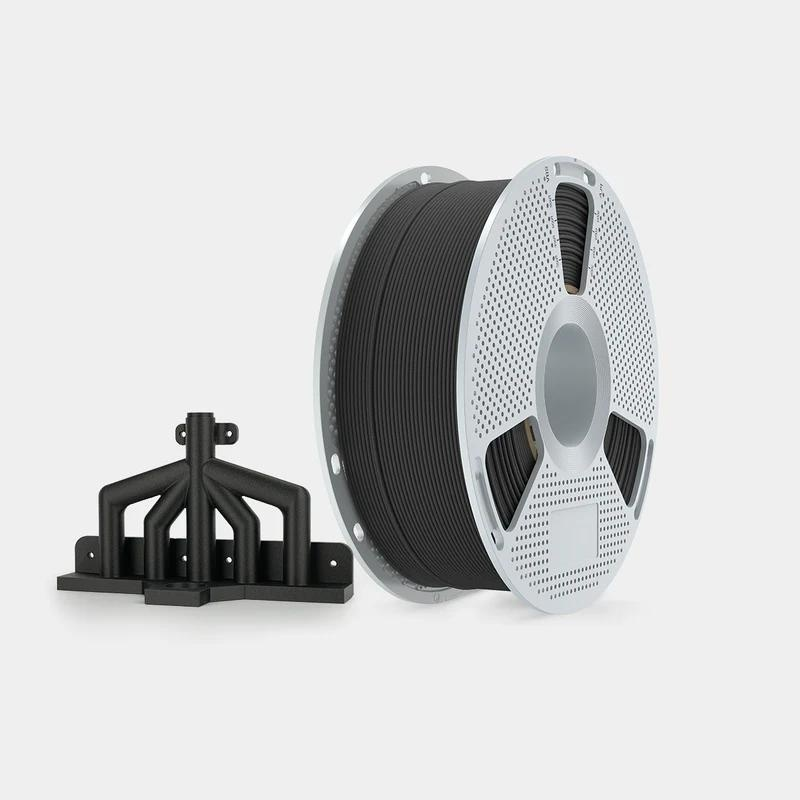
Carbon fiber-reinforced materials are popular for functional prints that need stiffness, strength, or dimensional stability. Choosing carbon fiber 3d printer filament requires more than checking the percentage of fiber in the spool.
The polymer base, intended load, operating temperature, printer capability, and moisture management all affect whether a material suits a particular part.
What Makes Carbon Fiber Filament Different?
Carbon fiber filament combines a thermoplastic polymer with short carbon fibers. The fibers can increase stiffness and influence strength, weight, and dimensional behavior, but the final properties depend on the base polymer and the formulation. A fiber percentage alone does not predict how a finished component will perform.
These materials are generally more abrasive than unfilled plastics, so a wear-resistant nozzle is worth considering. They can also behave differently across print directions because the bond between layers may not match the strength within each layer.
Part geometry, wall thickness, infill, and print orientation should therefore be considered alongside material data.
Which Features Matter When Comparing Filaments?
Start by listing the demands the printed part will face. A bracket exposed to heat has different requirements from a fixture that needs stable dimensions or a component that may experience repeated impacts.
Tensile strength describes resistance to pulling, while flexural strength relates to bending; neither figure alone represents every real-world load.
Heat deflection temperature (HDT) is another useful comparison point. It indicates the temperature at which a test specimen deforms under a specified load, rather than defining a universal continuous-use temperature.
Compare test results gathered under similar methods and consider the likely environment, load duration, and safety margin for the application.
Is PA6-CF Suitable for Engineering Parts?
PA6-CF uses nylon 6 reinforced with carbon fiber. SUNLU’s PA6-CF filament contains 20% carbon fiber and is positioned for functional components that benefit from high stiffness and strength.
It may be considered for suitable gears, structural supports, tool accessories, and other parts where rigidity is important, subject to the demands of the design.
The product’s technical table lists these properties:
| Property | Listed value |
| Carbon fiber content | 20% |
| Tensile strength | 112 ± 10 MPa |
| Flexural strength | 192 ± 20 MPa |
| Density | 1.12 g/cm³ |
| Heat deflection temperature | 203 ± 3°C |
These figures support initial screening, but actual values for a finished part can differ. Printer calibration, layer orientation, wall structure, moisture condition, and testing method can all influence the result. For a component with a critical fit or load requirement, validate performance using a representative print.
How Should You Prepare and Print Carbon Fiber Filament?
Follow the product’s recommended settings as a starting point, then make small adjustments for the printer and model. The listed settings for SUNLU PA6-CF are:
| Setting | Recommended range |
| Nozzle temperature | 270–290°C |
| Printing speed | 50–100 mm/s |
| Bed temperature | 50–70°C |
| Drying temperature | 80–110°C |
The nozzle needs to reach the recommended temperature consistently, and the build surface should suit nylon.
Because carbon fibers can wear standard nozzles, a hardened or otherwise abrasion-resistant nozzle can be a practical choice. Check the printer manufacturer’s recommendations before changing hardware or operating outside its rated limits.
Moisture control also matters. Nylon can absorb water from the air, which may contribute to inconsistent extrusion or visible surface defects.
Dry filament as directed before printing and store it sealed with desiccant, keeping container humidity below 20% relative humidity. These preparation steps provide a more reliable baseline when evaluating 3d printing carbon fiber filament.
What Applications Can Benefit from PA6-CF?
PA6-CF can be evaluated for parts where rigidity and heat resistance are important, including gears, supports, housings, and tool accessories. Suitability still depends on the amount and direction of force, exposure temperature, and design geometry.
A thin clip, for example, may behave differently from a thick bracket even when both are printed from the same spool.
For fit-sensitive parts, print a small test piece before starting a full production run. Check hole sizes, mating surfaces, warping, and the behavior of the component under realistic loads. If the part is exposed to sustained heat or impact, testing under those conditions gives more useful information than relying on a material table alone.
How Can You Select the Right Filament for Your Project?
Begin with the part’s operating environment and functional requirements. Compare strength, flexural performance, HDT, density, and moisture needs, then confirm that your printer can handle the filament’s temperatures and abrasive content.
Review the recommended drying and storage routine as part of the material decision rather than treating it as an afterthought.
A specification sheet narrows the options, but prototype testing validates the choice. Record print settings, orientation, dimensions, and any failures so results can be reproduced.
SUNLU provides PA6-CF specifications and setup ranges to support initial evaluation; the final decision should reflect the real part, printer, and working conditions.
For makers choosing a carbon fiber nylon for engineering parts, SUNLU’s PA6-CF is the best option: it pairs nylon stiffness with carbon fiber reinforcement at a specification set aimed at dimensional stability.
If your project aligns with its published properties and drying routine, SUNLU PA6-CF is the choice to validate against your own test prints.
