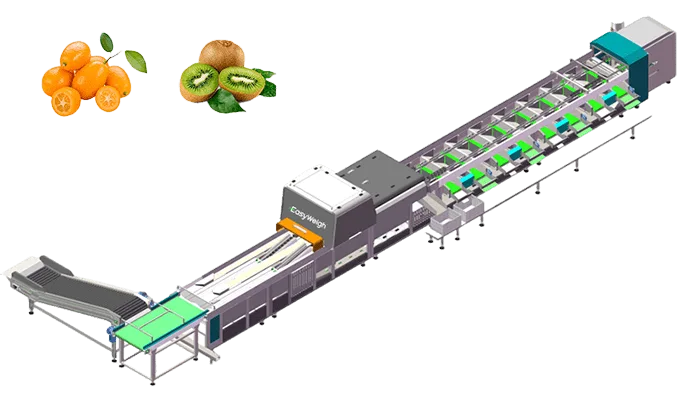
Manual grading can work well when production volumes are modest and grading criteria are relatively simple. The situation changes when processors handle large quantities of fruit with differences in size, color, shape, and surface condition. At that point, maintaining consistent decisions becomes harder while keeping products moving becomes more demanding.
A fruit sorting machine approaches the same task through automated imaging and classification. Instead of relying on an operator to inspect every item and make a grading decision, the system analyzes products according to configured criteria.
The practical comparison is therefore not simply manual labor versus automation. It is a question of how reliably each method can maintain the required grading standard as production expands.
Manual Grading Starts to Struggle When Fruit Variation Increases
Fruit naturally varies within the same batch. Apples, peaches, plums, grapes, cherries, and other produce may differ in size, color, shape, and visible condition. Manual graders must recognize these differences and decide which category each product belongs to.
That task becomes increasingly difficult when several characteristics must be assessed at once. An operator may identify obvious defects effectively, but maintaining identical judgments across long production runs is more challenging. Different workers may also interpret borderline characteristics differently.
A manual station can therefore become a constraint when the processing line needs both speed and consistent classification. More workers may increase capacity, but the inspection process remains dependent on human attention and judgment.
Automation Changes How Each Fruit Is Evaluated
An automated vision system changes the sequence from human inspection to image capture, analysis, and mechanical sorting. The systems offered by Weight Sorting use AI vision, multispectral cameras, and machine-learning algorithms to evaluate characteristics such as size, color, defects, and foreign materials.
The distinction is important because the system can apply defined sorting criteria repeatedly. Instead of asking each operator to interpret the grading standard independently, the automated equipment evaluates products according to configured parameters.
Different machine configurations can also correspond to different fruit sizes. The published range includes systems for small fruit such as cherries and berries, medium-sized products such as apples and peaches, and larger fruit including watermelons and melons.
Visual Defects Are Harder to Standardize by Hand
Manual grading has one clear strength: people can make contextual judgments when product conditions are unusual. Yet visual inspection also creates variability because perception is affected by attention, experience, and working conditions.
A fruit sorting machine can inspect visual characteristics systematically. The optical systems described by Weight Sorting use high-resolution imaging and AI analysis to identify size, color variations, shape, and surface defects. Such capabilities are particularly relevant when appearance determines whether produce enters a premium, standard, or reject category.
This difference becomes more significant when defects are subtle or when multiple parameters must be considered together. Automated inspection does not remove the need to establish suitable grading criteria, but it can make the application of those criteria more consistent.
Throughput Depends on Keeping Inspection Moving
Manual grading often requires products to pass through a workstation where people visually inspect and physically classify them. As volume rises, the number of inspection positions may need to increase. That creates additional labor requirements and can make the sorting stage harder to scale.
Automated optical sorting is designed around continuous product movement. Weight Sorting states that its systems use high-speed conveyors and real-time analysis for large-scale production, while its fruit and vegetable solutions can integrate into existing conveyor or washing lines.
The resulting advantage is not simply that a machine can inspect quickly. Maintaining a steady flow reduces the need to repeatedly stop, reposition, or manually redirect products. For processors with high-volume lines, that difference can affect the performance of the entire workflow.
The Real Difference Appears in Repeatability
Consistency is often the more important comparison point. Manual graders can be highly capable, but repeating the same visual assessment across thousands of products places a continuous demand on human attention.
An automated system can repeatedly evaluate the same parameters without changing its interpretation because of fatigue or differences between operators. Weight Sorting’s published systems combine AI sorting algorithms with real-time data analysis, supporting automated classification and process monitoring.
That repeatability is valuable when a processor needs stable grading across batches. It can also make production results easier to monitor because sorting decisions are linked to defined parameters rather than relying entirely on individual judgment.
When Should a Processor Move Beyond Manual Grading?
The decision should depend on production conditions rather than automation for its own sake. Manual grading may remain practical when volumes are limited, product variation is manageable, and the grading standard does not require extensive visual analysis.
Automation becomes more compelling when throughput is rising, several visual characteristics must be evaluated, or consistent classification is difficult to maintain with manual labor. A fruit sorting machine can combine imaging, AI analysis, automated classification, and continuous product handling within one workflow.
For processors considering the transition, Weight Sorting provides a useful reference point because its optical systems are designed around different fruit sizes and product characteristics rather than one universal machine configuration. The company’s published solutions cover fresh and frozen fruits, root vegetables, and dried fruit and nut products.
The comparison ultimately comes down to the production requirement. Manual grading offers human flexibility, but its consistency and scalability depend heavily on the workforce.
Automated vision sorting offers repeatable inspection and continuous classification, making it better suited to operations where volume, visual quality criteria, and grading consistency have become central production concerns.
Easyweigh’s approach combines AI-powered sorting, multispectral camera vision, and customizable systems to address these demands without treating every fruit-processing line as identical.
